Digital Services Regulation or DSA: obligations and services concerned

    Translations are provided as a service to Arcom users and are supplied “as is”, throught the DeepL tool. Consequently, only the text of the original version is authentic.

    Find out more about translation

    [Page updated April 7, 2025]

    The European Digital Services Act (DSA) aims to regulate the activities of digital intermediary service providers, which online platforms are within the scope of.

    Introduction and regulatory framework

    The aim of the RSN is to make digital players more responsible for fighting the spread of unlawful, harmful or illegal content on their services, or content that contravenes their terms of service.

    The aim of the regulation is to provide better protection for Internet users.

    1. Since August 2023, the Regulation has applied to very large online platformsand search engines (VLOPSEs), each of which is used by at least 45 million EU citizens.
    2. Application has been extended to all intermediary service providers since February 17, 2024, under the supervision of national authorities.

    The text makes provision for each EU country to designate one or more competent authorities to enforce the text and, among them, an independent authority to perform the functions of "coordinator for digital services" (CSN) responsible for ensuring consistent implementation of the regulation at national level. The law aimed at securing and regulating the digital space, promulgated on March 21, 2024, designates Arcom as the coordinator for digital services for France, alongside two other competent authorities: the French national data protection agency (CNIL) and the General Directorate for Competition, Consumer Affairs and Fraud Control (DGCCRF).

    Which departments are involved?

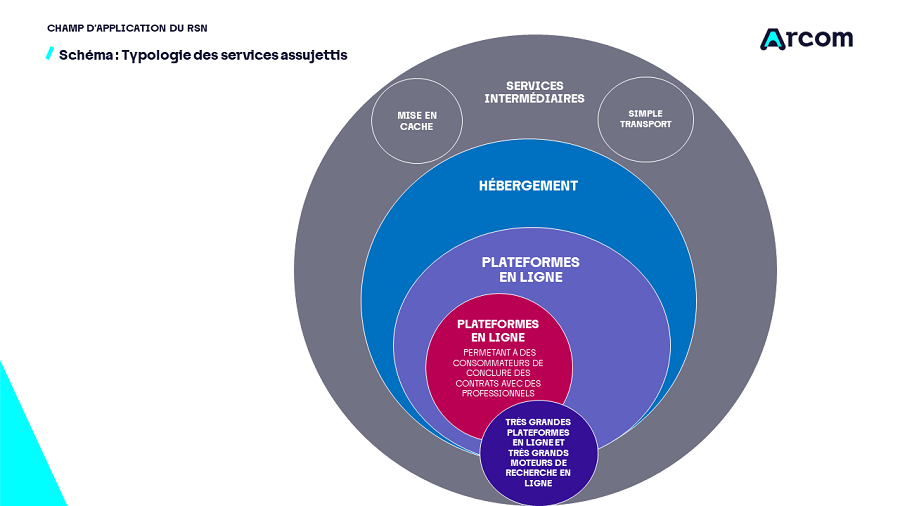
    The definitions of these categories and of the concept of information societyservice are set out, respectively, inArticle 3 of the NSR and Article 1(1)(b) of Directive (EU) 2015/1535.

    Provisions tailored to the size of intermediary service providers: intermediary service providers that can be qualified as microenterprises or small enterprises (i.e. those employing fewer than 50 people and whose annual turnover or annual balance sheet total does not exceed €10 million) and that are not very large online platforms and very large online search engines (VLOPSEs) are exempt from certain obligations of the Regulation (cf. Articles 15 (2), 19 and 29).

    Règlement sur les services numériques : schéma des services. © Arcom

    Who are VLOPSES and what are the special features of their diet?

    Very Large Online Platforms and Search Engines (VLOPSEs) are officially designated by the European Commission.

    The European Commission maintains a list of designated VLOPSEs.

    The European Commission has exclusive powers to monitor and enforce compliance with the specific provisions (chapter III section 5) which apply to these services (cf. article 56 (2) and (3) of the RSN). The national authorities of the Member State in which the main establishment of a very large online platform or search engine is located are also responsible for the other provisions of the regulation (notably chapters II and III, sections 1 to 4).

    Bonds

    Summary of NSR obligations applicable according to the type of intermediary service.

    • articles 9 and 10: Handling of administrative and judicial injunctions to act against unlawful content or to provide information
    • articles 11 and 12: Designation of a contact point for authorities and service recipients
    • article 13: Designation of a legal representative on EU territory for providers not established in the European Union
    • article 14: Clear and intelligible terms of service
    • article 15: Annual transparency reports on moderation policy

    • article 16: Implementation of notification and action mechanisms (reporting tools)
    • article 17: Statement of reasons for moderation decisions taken against service users
    • article 18: Notification of judicial authorities in the event of suspicion of infringement of criminal law likely to harm or having harmed the life or safety of third parties.

    • article 20: Establishment of an internal scheme for handling reports and complaints
    • article 21: Informing service users about out-of-court dispute settlement channels and the conditions for using them
    • article 22: Diligent cooperation with trusted flaggers
    • article 23: Measures to fight and protect against abusive use, in particular the diffusion of manifestly unlawful content
    • article 24: Additional information to be published in the report provided for in article 15
    • article 25: Design and organization of the service's online interfaces - prohibition of "misleading interfaces"(Dark patterns)
    • article 26: Supervision of online advertising presentations
    • article 27: Transparency of the online notice scheme
    • article 28: Protection of persons under 18 online

    • article 30: Traceability of professional vendors
    • article 31: Complianceby design
    • article 32: Consumers' right to information

    Schema: which obligations for which services?

    Integration into the European Commission database

    If you provide one or more online platform services, please pre-register by following this link to join the European Commission's database, to which you will need to transmit the decisions and statements of reasons referred to in Article 17, paragraph 1 (art. 24.5). This provision is not compulsory for micro and small companies (fewer than 50 employees and less than 10 million euros in sales or balance sheet total).

    Additional information (SIREN, VAT number, address, etc.) will subsequently be demanded by the coordinator for digital services in your country of establishment to finalize the registration.

    Registration of an online platform on the transparency database (art. 24.5)

    Transparency report (art. 15, 24 and 42 RSN)

    Intermediary service providers subject to the RSN must publish an annual transparency report (excluding micro and small companies, and half-yearly for VLOPSEs) describing, among other things, their moderation activities, receipt of alerts and handling of injunctions. Articles 15, 24 and 42 of the RSN set out the information to be included in the report, as well as the procedures for publishing it, and are specified in an implementing regulation adopted at European level on November 4, 2024.

    This implementing regulation makes provision for the compulsory use of a model for drafting these reports, as of the second half of 2025. The implementing regulation is available here, along with the template in XLSX format (appendix 1) and a note presenting instructions for filling in the template (appendix 2). This corpus of documents is also available here in French in pdf format.

    Find below the explanatory presentation of this regulation, which served as the basis for two workshops for French service providers subject to the RSN organized at Arcom in March and April 2025.

    Workshop on the implementing regulation on transparency reports.

    What is Arcom's role?

    As coordinator, Arcom is the reference authority for, among other things:

    Ensure that French intermediary service providers implement adequate means to comply with the RSN provisions it is responsible for overseeing*. This includes receiving and handling complaints when an operator fails to comply with the RSN. When it receives a complaint concerning a service provider established in another EU member state, Arcom can forward it to the coordinator in that state;

    Ensure that French online platforms contribute to the European database of statements of reasons sent to users when a moderation decision is made on their content;

    Designate trusted flaggers, whose reports of unlawful content must be given priority by platforms;

    Certify out-of-court dispute settlement bodies established in France, which will examine individual cases when a user wishes to contest a moderation decision;

    Centralize injunctions issued by French judicial and administrative authorities, on the basis of the regulation, to operators (injunction to act against unlawful content or injunction to provide information on a user or users), and forward them to all European coordinators for digital services (CSN).

    As a coordinator, Arcom is within the scope of the European Digital Services Committee, which includes the digital services coordinators of all member states. It cooperates closely with them. Arcom is also in constant contact with the European Commission, which it supports in its missions, notably the supervision of very large online platforms and search engines.

    Two competent authorities have been appointed to work alongside Arcom: the Direction Générale de la Concurrence, de la Consommation et de la Répression des Fraudes (DGCCRF) and the Commission Nationale de l'Informatique et des Libertés (CNIL). Arcom ensures that the authorities cooperate closely and provide mutual assistance, within the framework of RSN enforcement (article 51 of the law to secure and regulate the digital space SREN). In the event of non-compliance with the regulations, and as a last resort, Arcom also has the power to impose legal sanctions on French players who fail to meet the obligations it is responsible for supervising.

    * Arcom is responsible for monitoring the application of all the above-mentioned obligations, with the exception of articles under the control of the French national data protection agency (obligations linked to advertising profiling, art.26.1.d, art.26.3, art.28.2) or the DGCCRF (art.30, 31 and 32; art.25 for its application to marketplaces).

    Contact

    Should you require further information, please send your questions to the following address, dedicated to intermediary service providers: professionnels-dsa@arcom.fr

    Please specify your company name at the beginning of the subject line, for example as follows:

    • [your company name] Mail title