Image
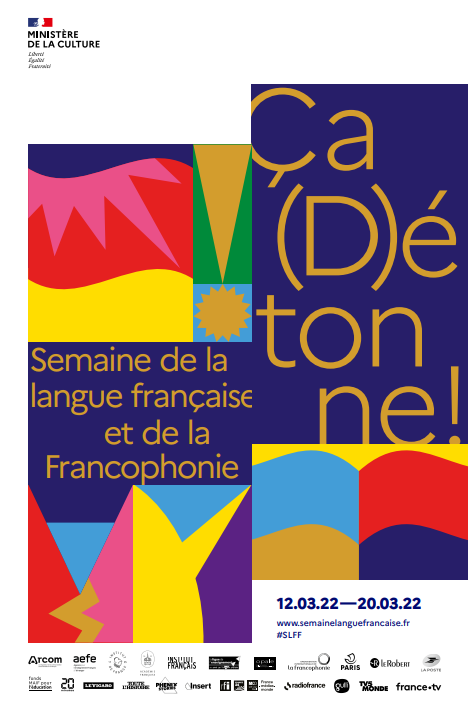


The French regulatory authority for audiovisual and digital communication, Arcom, a partner of the Semaine de la langue française et de la Francophonie 2022, from March 12 to 20, is encouraging TV and radio channels to promote the use and respect of French.
French, the world's 5th language, is spoken by over 300 million people worldwide. By 2050, it is expected to be spoken by 850 million people.
The French language is the raw material of the media. The media play a decisive role in the vitality of our language. Through it, they transmit a vision of the world, cultures, values and shared histories. That's why it's up to them to act as ambassadors for the French language, to bring it to life and show its richness and diversity on a daily basis.
Arcom's authority to defend and promote the French language stems from a number of legal texts, which require it to monitor the use of French in all broadcasts and advertising messages.
The specifications of France Télévisions, Radio France and France Médias Monde contain provisions on the use of the French language. For private television companies, more flexible obligations are included in their agreements.
The AMF is calling on all TV and radio stations in mainland France and the French overseas territories to take action to promote the French language, and to make provision for special programming on their airwaves.
Arcom's action, monitored by the"Education, audience protection and social cohesion in audiovisual and digital media" working group chaired by consultant Carole Bienaimé Besse, focuses on three main areas:
The Semaine de la langue française et de la francophonie dans les médias is an opportunity for channels to promote the French language in their programs and through promotional spots.
The good news is that French-speaking viewers and listeners are particularly concerned about the proper use of the French language on the airwaves, and they're letting us know. We do our utmost to respond to the many e-mails we receive.
Approximate use of the subjunctive, confusion between prefixes, pronunciation of city names, subtitling and conjugation... Every month, Arcom is called to account for the grammatical and spelling errors, or unfortunate syntactical twists and turns, that sometimes creep into programs or news broadcasts. Here are some answers to your questions.
Viewers and listeners are always a little annoyed when they hear the name of their town or village mispronounced by journalists.
A majority of the letters received on this subject concern the city of Brussels, pronounced [bruksel] instead of [brussel], just as Auxerre and Metz are pronounced [ausserre] and [mess], as the dictionaries indicate.
Chamoniards also point out that their town is pronounced [chamoni], not [chamonix]. The Albenassiens want to hear the name of their town pronounced [aubena], not [aubenass]. The same applies to the Privadois, with Privas to be pronounced [priva]. On the other hand, some forty kilometers from these two main towns, the small town of Lussas, which hosts the Etats Généraux du Film Documentaire every August, is very often summoned [lussa], whereas its inhabitants let the final s be heard and say [lussass].
While Agen and Le Pouliguen have nasalized endings and are pronounced [in], Pont-Aven rhymes with dolmen.
While the Traité de prononciation française indicates that the l is silent in the names Aulnaye, Aulnoye-Aymeries, the Petit Larousse illustré (1999) gives two variants [aunay] [aunoy] or [aulnay] [aulnoy].
The same development can be seen in the pronunciation of the town and territory of Belfort. There used to be two pronunciations, one regional without the l, the other with an l. The latter prevailed, but today the pronunciation [befort] is found not only among older people, but also among youngsters whose families have been from Belfort for several generations.
It should also be remembered that before it was pronounced [ménilmontant], the Paris district was summoned [ménimontant].
Are you [montpeulier], [montpélier] or [montpéyé]?
A viewer from the Paris region wrote to the French Superior Audiovisual Council to complain about the pronunciation of the town of Montpellier in the audiovisual media, with the exception of one journalist who, according to him, pronounces it correctly as [montpélier] and not [montpeulier].
In Montpellier, the local press echoes the passionate controversy over the correct pronunciation of the toponym.
The Barons and Baronnes de Caravette, honorary titles given to Montpellier residents whose parents, grandparents and great-grandparents were born and have lived in Montpellier for three generations, are divided: some claim [montpeulier], others defend [montpélier].
The "authorized" opinion of certain researchers was sought, and a survey was carried out, within the framework of the CNRS, on a sample of 542 people, representative of the Montpellier population. This work led to the publication of a book entitled Les noms de Montpellier.
For Jacques Bres, the book's coordinator, the variation [montpeulier] [montpélier] can be explained in two non-exclusive ways. Montpellier is pronounced [montpéyé] in Occitan.
The Occitan é in the atonic medial syllable regularly becomes [eu] in French. The pronunciation [montpeulier] corresponds to standard French, while [montpélier] is a regional French trace of the name's Occitan origin.
There is also a spelling rule that the letter e is written in French without an accent if it is followed by a double consonant, but is pronounced [é], as in cellier.
This shows that there is no single correct pronunciation, but that both variants are equally correct and equally legitimate.
If today 90% of people pronounce [montpeulier] and 10% [montpéllier], no linguist can predict the future. Whether [montpélier] will stabilize and begin to regain ground, or whether it will diminish or even disappear...
It should be noted, however, that both pronunciations are now attested in Larousse dictionaries, whereas only [montpeulier] appeared in earlier editions.
When speaking, it's the future tense and the present conditional that are most frequently overused: "vous metteriez" for "vous mettriez", "vous résolverez" instead of "vous résoudrez".
The verb acquire and, less frequently used, the verb conquer pose problems not only in the future and conditional tenses ("vous acquérirez" for "vous acquerrez") but also in the past tense ("ils ont conquéri" instead of "ils ont conquis").
The verbs croire and voir create even more hesitation and give rise to new forms of conjugation. These two verbs have different written forms in the third person singular and plural, present indicative and present subjunctive: "il croit, ils croient, pour qu'il croisie, pour qu'ils croient", "il voit, ils voient, pour qu'il voie, pour qu'ils voient". And yet they're all pronounced the same, [voi] and [croi].
To distinguish the singular from the plural, we increasingly hear guests, and sometimes even hosts, use forms that don't exist in our conjugation: "ils croivent, ils [voillent] orthographiée ils voyent, whether in the indicative or subjunctive.
In the written word, on the other hand, whether in inlays or subtitles, the present subjunctive of these two verbs is mostly ignored and replaced by the present indicative ("pour qu'il croit" instead of "pour qu'il croie", "pour qu'il voit" instead of "pour qu'il croie"). pour qu'il voit" instead of "pour qu'il voie").
The subjunctive of the verb avoir "qu'il ait" frequently becomes "qu'il aie", through confusion with "que j'aie" or with the imperative aie. The forms "ayons, ayez" and "soyons, soyez", on the other hand, are misspelled (ayions, ayiez), (soyions, soyiez) with an unnecessary and incorrect y.
The verb to conclude has disappeared in favor of the verb to conclude, judging by the frequency, on TV and in the press, of the forms "il conclue, il conclera" instead of "il conclut, il conclura" learned at school.
In the second person, the present imperative of verbs in the first group continues to be spelled with an s: "chantes" instead of "chante", despite the rule: "The second person singular of the present imperative of verbs in -er (except aller, "va") ends in e, except in front of the pronouns en and y not followed by an infinitive.
Compare "Sing, dance, travel" with "Eat some. Think about it. Vas-y" (hyphenated s) or "Va y porter ordre. Ose en dire du bien" (en and y followed by an infinitive) and even "Va-t'en. Retourne-t'en.", with apostrophe, the t not being an analogous consonant as in "Aime-t-il?" but the pronoun te, the e of which is elided, the apostrophe dispensing with the second hyphen.
The subtitles often display whimsical conjugations. Errors regularly found concern the present tense, whether subjunctive: "que nous ayons", "que vous soyez" spelled with an unnecessary "i" ("que nous ayions", "que vous soyiez"), or imperative: "chante", often with an incorrect final "s" ("chantes"); and even the present indicative: "il envoie" written "il envoit" or "il conclut" spelled "il conclue". Similarly, the future tense of conclude raises a number of difficulties: it is found in the form "il concluera" for "il conclura".
The anticipatory agreement of the word "espèce" with a masculine complement in the expression "un espèce de savant fou" is frequent in the audiovisual media, but remains rare in the written press.
Maurice Grevisse points out that the adjectival character of the phrase "species of" is such that species itself frequently takes on the gender of the noun complement: un espèce de prophète. He also notes that espèce was already sometimes treated as masculine in the 18th century: "un espèce de cabinet" (Saint-Simon), "un espèce de grand homme" (Voltaire), "un espèce de musicien" (Diderot).
Despite these lists of our language's history, dictionaries and grammars are quite clear. As the ninth edition of the Dictionnaire de l'Académie reminds us, the word espèce is always feminine, whatever the gender of its complement.
For its 27th edition, the Semaine de la langue française et de la Francophonie (French Language and Francophonie Week) is focusing on the theme "ça (d)étonne! The official launch of this week of events around the French language and Francophonie was given at the Ministry of Culture, by the Minister of Culture, Roselyne Bachelot-Narquin, and by the patron of this new edition Michel Boujenah, Franco-Tunisian actor, director and humorist.
Launch of #SLFF2022 by @R_Bachelot and @MichelBoujenah | March 12-20
- Carole Bienaimé Besse (@CaroleBienaime) March 9, 2022
The Semaine de la Langue Française et de la Francophonie in@Arcom_fr media is part of this manager.
Thanks to our ambassadors @ACCoudray #JCNarcy @Daphne_Burki01 @RaphalYem @HapsatouSy et aux ? pic.twitter.com/5smJX4oCdV
More than 1,000 events and programs around the French language and/or the Francophonie are organized and scheduled throughout the week of March 12 to 20.
The week is an opportunity to showcase cultural venues through activities and events organized for the occasion: dictation competitions, exhibitions, writing workshops, improvisation shows, etc...
For the full program in France and abroad: